Helena was the pioneer in mylar supported cellulose acetate and it is still widely used today. Below are the necessary materials for performing the assays. See Electrophoresis Supplies for information on the Titan IV Power Supply, Titan Gel Chamber and other supplies.
Titan III Hemoglobins
Electrophoresis is generally considered the best method for separating and identifying abnormal hemoglobins. Via a two-step process, blood samples are initially screened using alkaline hemoglobin electrophoresis, followed by confirmation of abnormals by electrophoresis at an acid pH. Helena offers acetate, agar and agarose zone electrophoresis methods as well as a capillary electrophoresis assay. Titan III acetate offers a quick, easy and cost-effective manual method for hemoglobin screening.
See also:
Titan IV Citrate Hemoglobins
SPIFE Alkaline and Acid Hemoglobin Electrophoresis methods.
QuickGel Alkaline and Acid Hemoglobin Electrophoresis.
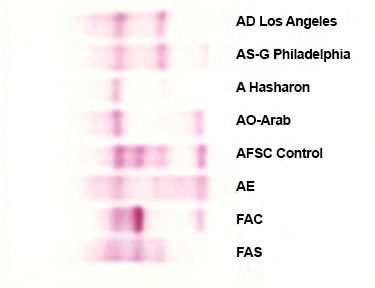
Titan III-H Cellulose Acetate and Supre-Heme Buffer for Hemoglobins
Cat. No. / Item / Description
3021 – Titan III-H Cellulose Acetate – 94 x 76 mm
3022 – Titan III-H Cellulose Acetate – 60 x 76 mm
5802 – Supre-Heme Buffer – 10 x 14.6 g
Titan III-H Cellulose Acetate membranes are for use in the alkaline hemoglobin electrophoresis. Membranes are available in two sizes and packaged 25 per box. Supre-Heme Buffer is a Tris-EDTA-Boric Acid buffer used in the alkaline hemoglobin procedure.
For Titan IV Citrate Acid Hemoglobins, see Cat. No. 2400.
Hemolysate Reagents
Cat. No. / Item / Description
5125 – Hemolysate Reagent – 1 x 250 mL
5127 – Hemolysate Reagent w/o KCN – 1 x 250 mL
5128 – Hemolysate Reagent (Powder) – 1 x 1.8 g
This reagent hemolyzes red blood cells and stabilizes hemoglobin in one easy step. It eliminates many tedious, time-consuming steps in preparing hemolysates. The reagent contains 0.005 M EDTA with 0.07% potassium cyanide to assist in stabilizing the hemoglobin. The powdered reagent is dissolved in 1.0 liter deionized water.
Alkaline Hemoglobin Stain
Cat. No. / Item / Description
5526 – Ponceau S Stain – 1 x 10⁵ g
Multi-purpose protein stain, especially useful for serum proteins and alkaline hemoglobins on cellulose acetate. Dissolve in 1000 mL deionized water.
Acetate Clearing Solutions
Cat. No. / Item / Description
5005 – Clear Aid – 1 x 250 mL
4950 – PermaClear – 1 x 1 L
Clear Aid: Clearing solution additive that prevents cellulose acetate from shrinking during the clearing step. Add this high molecular weight elastomer as directed in the cellulose acetate procedures for proteins and alkaline hemoglobins.
PermaClear: A substitute for the clearing solution prepared with Clear Aid. Dilute PermaClear with deionized water (55 mL PermaClear/45 mL water).
Hemoglobin Controls
Cat. No. / Item / Description
5328 – AA2 Hemo Control – 1 x 1 mL
5329 – ASA2 Hemo Control – 1 x 1 mL
5330 – AFSA2 Hemo Control – 1 x 1 mL
5331 – AFSC Hemo Control – 1 x 1 mL
Hemo Controls are stabilized liquids prepared from fresh-packed human red blood cells hemolyzed with Hemolysate Reagent. They are for qualitative and quantitative use in identification and quantitation of hemoglobins. AFSC Hemo Control is recommended for use with citrate agar.
Titan III Proteins
The key roles which serum proteins play in bodily functions and the relative ease of separating them by electrophoresis, makes their determination a valuable diagnostic tool as well as a way to monitor clinical progress. Titan III cellulose acetate allows manual separation of proteins into the classic 5-bands with Ponceau S for staining. Finished plates are stable in storage.
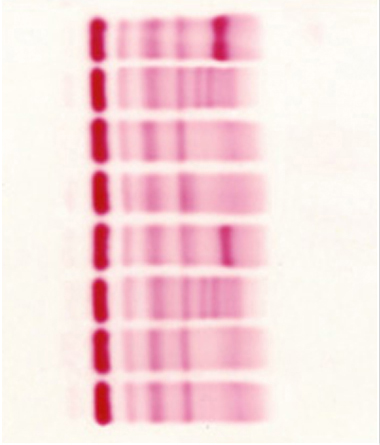
Titan III Cellulose Acetate and HR Buffer for Proteins
Cat. No. / Item / Description
3023 – Titan III Cellulose Acetate – 60 x 76 mm
3024 – Titan III Cellulose Acetate – 94 x 76 mm
3013 – Titan III Cellulose Acetate – 76 x 25 mm
3033 – Titan III Cellulose Acetate – 76 x 76 mm
5805 – Electra HR Buffer – 10 x 18 g
Titan III Cellulose Acetate membranes are for use in separation and quantitation of serum proteins. Membranes are packaged 25 per box. Electra HR-Buffer is a tris-barbital/sodium barbital buffer for use in separating proteins by cellulose acetate electrophoresis.
Serum Protein Stain
Cat. No. / Item / Description
5526 – Ponceau S Stain – 1 x 10⁵ g
Multi-purpose protein stain, especially useful for serum proteins and alkaline hemoglobins on cellulose acetate. Dissolve in 1000 mL deionized water.
Acetate Clearing Solutions
Cat. No. / Item / Description
5005 – Clear Aid – 1 x 250 mL
4950 – PermaClear – 1 x 1 L
Clear Aid: Clearing solution additive that prevents cellulose acetate from shrinking during the clearing step. Add this high molecular weight elastomer as directed in the cellulose acetate procedures for proteins and alkaline hemoglobins.
PermaClear: A substitute for the clearing solution prepared with Clear Aid. Dilute PermaClear with deionized water (55 mL PermaClear/45 mL water).
Serum Protein Controls
Cat. No. / Item / Description
3424 – SPE Normal Control
3425 – SPE Abnormal Control
These lyophilized controls are prepared from pooled human serum and are for use with Titan III Cellulose Acetate as well as SPIFE SPE Vis and Split-Beta SPE kits. Reconstituted controls are stable 5 days stored at 2 to 8°C. Each control is assayed for total protein, albumin, alpha1, alpha2, beta and gamma globulins.
Titan III Lipoproteins
Hyperlipidemia is symptomatic of a group of disorders dissimilar in clinical features, prognosis, and responsiveness to treatment. Lipoproteins can be separated on Titan III cellulose acetate into alpha, pre-beta, and beta lipoproteins and on occasion, chylomicrons to aid phenotyping and establishment of therapy.
See also: SPIFE Lipoproteins
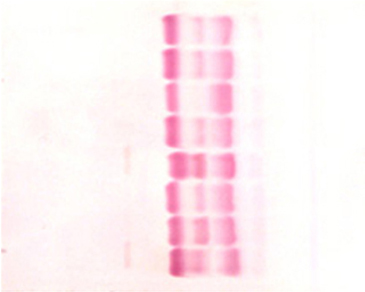
Titan III Cellulose Acetate and HR Buffer for Lipoproteins
Cat. No. / Item / Description
3900 – Titan III Lipo Cellulose Acetate – 60 x 76 mm
5805 – Electra HR Buffer – 10 x 18 g
Titan III Lipo membranes are cellulose acetate support media used for lipoprotein phenotyping. Membranes are available in three sizes and are packaged 25 per box. Electra HR Buffer is a tris-barbital/sodium barbital buffer for use in the separation of lipoproteins by cellulose acetate electrophoresis.
Lipoprotein Stain
Cat. No. / Item / Description
5322 – Lipoprotein Stain – 1 x 2.8 g
Used in conjunction with Titan III Lipo cellulose acetate, this stain is consistently reproducible and testing easily performed. To use, dissolve powdered stain in 1.0 liter methanol.
Lipoprotein Control
Cat. No. / Item / Description
5069 – LipoTrol – 5 x 1 mL
LipoTrol fills the need for a reliable control for lipoprotein electrophoresis. It contains alpha, pre-beta, and beta lipoprotein bands with the relative percent of each band provided. LipoTrol is prepared from human serum and is for use with both the cellulose acetate and agarose systems. Reconstituted control is stable 3 days at 2 to 6°C.
Titan III Alkaline Phosphatase Isoenzymes
Alkaline phosphatase (ALP) in human serum originates from several tissue sources with the greatest activity resulting from bone, liver, intestine and placenta. Because of the wide distribution, limited information can be obtained from a total ALP assay. Fortunately the tissue sources of elevated ALP in serum can be determined by identifying the isoenzyme. ALP isoenzymes differ in their physicochemical and electrophoretic properties, and by taking advantage of these differences, individual isoenzymes can be identified. In addition to liver, bone, intestinal and placental isoenzymes, Regan, PA, Nagao and renal isoenzymes have also been identified.
Titan III Cellulose Acetate ALP Procedure Total Time: approximately 50 minutes.
See also: SPIFE Alkaline Phosphatase Assay
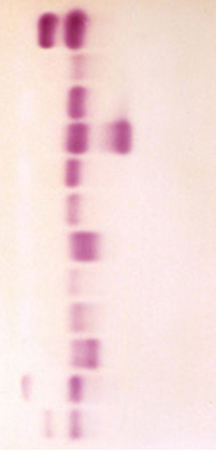
Alkaline Phosphatase Indoly Blue Reagents
Cat. No. / Item / Description
5102 – ALP Indolyl Blue Reagent – 10 x 3 mL Reagent – 1 x 30 mL Diluent
This reagent is for colorimetric development of ALP isoenzyme bands after electrophoresis. Results obtained with Indolyl blue are easily visualized and interpreted due to the uniform white background and bright intense bands.
Alkaline Phosphatase Isoenzyme Control
Cat. No. / Item / Description
5139 – ALP Isoenzyme Control – 1 x 1 mL
The control contains liver and intestinal alkaline phosphatase isoenzymes. It is prepared from tissue homogenates and is for qualitative use with the Titan III cellulose acetate system. The control is a stabilized liquid.